Stauros Means Stake
This information was taken from historical books, documents, Wikipedia and of course the most notable of all ancient sources, the Bible. The blog you are about to read has been researched, organized, and laid out using information that may be offensive to some readers. These analysis were not put together in judgment, malice or grievance toward any group or individual. This information is esoteric and intended to assist the followers of “the way,” in discovering new information.

Scholars note that the primary, original meaning of the ancient Greek word stauros (translated in the New Testament as cross) was actually a upright pale, pole, or single stake.
Synonyms: The New Testament also uses the word xylon, which translates simply as “wood,” “timber,” or “tree” (e.g., Acts 5:30).
Acts 5:30 The God of our ancestors raised Yeshua from the dead—whom you killed by hanging him on a tree.
The Christian Cross
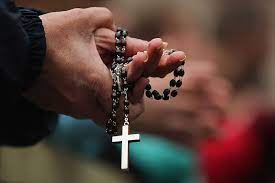
The English word cross actually traces back to Old Norse (kross) and old Irish (cros) and to the Latin noun crux, meaning a stake, gallows, or instrument of execution. It ultimately displaced the native Old English word rōd. As with the “rod of Asclepius” which you will discover later in this blog.
Constantine The Great
In 312 CE Roman Emperor Constantine the Great reportedly saw a vision of a cross or Christogram in the sky with the Greek words “In this sign, conquer” before the Battle of the Milvian Bridge. He ordered his troops to place the Chi-Rho (superimposed Greek letters Chi [X] and Rho [P] representing Christ) on their shields and military standards.
The Constantine symbol, known as the Chi-Rho (☧), represents Jesus Christ, divine victory, and the protection of the Christian God. It combines the first two Greek letters of Christ’s name—Chi (X) and Rho (P)—superimposed on one another.
In the past, the Greek Christ was not spelled as it is today in English. The Greek letter “Rho” in Chi Rho is the Greek letter P (rho) and resembles the English letter P, it makes the “R” sound. Together with the letter Chi which looks like an English letter (X), it forms the first two letters of the Greek word for Christ (Christos). In the past many used the initial “X” to represent Christ.

I watched as the Lamb opened the first of the seven seals. Then I heard one of the four living creatures say in a voice like thunder, “Come!” 2 I looked, and there before me was a white horse! Its rider held a bow, and he was given a crown, and he rode out as a conqueror bent on conquest. (Revelation 6:1-2)
Constantine claimed when he fell asleep, Christ appeared to him in a dream, commanding him to make the likeness of a sign.
Because the physical structure of the labarum used a vertical spear and a horizontal crossbar, observers and later generations naturally associated its framework with the shape of the cross. Wikipedia
“By placing this hybrid emblem on shields, coins, and military banners, Constantine shifted a symbol previously tied to criminal execution into a glorious emblem of Roman power and divine favor.” Kenny Ang
Constantine Became The Little Horn, Creating (the Pope) a position that was both powerful and blasphemous!
Again we see the contrast between YEHOSHUA and Jesus. We know YEHOSHUA would never go against the FATHER’s command that way! He would never encourage or condone idolatry!
You shall not make for yourself a carved image, or any likeness of anything that is in heaven above, or that is in the earth beneath, or that is in the water under the earth. Exodus 20:4
The Ankh

Ancient Egyptians called this ancient sigil the ankh, which translates to “life” or “breath of life”. It is shaped like a cross with a loop or oval at the top and is often referred to as the key of life.
“The ankh or key of life is an ancient Egyptian hieroglyphic symbol used to represent the word for ‘life’ and, as a symbol of life itself.” as noted by Wikipedia.
The Ankh originally belonged to polytheistic ancient Egyptian deities (like Osiris and Isis) as a hieroglyph for “life”. However, when Egyptians converted to Christianity in the 1st through 4th centuries CE, they seamlessly transferred the symbol to Jesus. Known as the Crux Ansata (the “handled cross”), the early Coptic Church used the loop to symbolize the eternal nature of God the Father, and the crossbars to represent Christ’s death
True believers know life comes only from YEHOSHUA, not from some metal idol or piece of carved wood.
Yeshua said to her, “Your brother will rise again.” 24 Martha answered, “I know he will rise again in the resurrection at the last day.”
Yeshua replied, I am the resurrection and the life. The one who believes in ME will live, even though they die;
26 and whoever lives by believing in ME will never die. John 11:25-26
YEHOSHUA was accused of blasphemy by evil corrupt men, who caused HIS execution!
He was accused of claiming that HE was the Messiah and the King of all Yehudim, which the Sanhedrin viewed as a direct challenge to established religious law and authority.
According to them, this was blasphemy, sedition or treason before the Roman authorities.
Then the high priest tore his clothes and said, “He has spoken blasphemy! Why do we need any more witnesses? Look, now you have heard the blasphemy. Matthew 26:65
The Bible confirms that YEHOSHUA did no such thing. HE traveled miles, teaching, healing and spreading the Good News!
Matthew 4:23 Yeshua went throughout Galilee, teaching in their synagogues, proclaiming the good news of the kingdom, and healing every disease and sickness among the people.
Classical Antiquity (800 BCE – 500 CE)
(Stipes) was a standard form of capital punishment in antiquity. These practices were extensively used by the Romans, Carthaginians, and Persians before Roman Emperor Constantine the Great, officially abolished legal crucifixion (or stipes) in the 4th century CE.
But he was wounded for our transgressions, he was bruised for our iniquities: the chastisement of our peace was upon him; and with his stripes we are healed. Isaiah 53:5
Ancient classical writers used terms like the Greek stauros and Latin crux or stipes to describe an upright pale, pole or single wooden stake used for fence-making support, or executing criminals. In early classical Greek, such as the writings of Homer (c. 850 BCE), the word meant a plain upright stake or pole rather than a two-beamed cross.
Unfortunately, for some strange and highly unusual reason people today equate a wooden cross (an idol) with their passion for “Jesus.” This actually confirms how Jesus is in no way affiliated with the “TRUE GOD.” This is made quite clear as GOD commanded absolutely no idols. YEHOSHUA would never go against HIS FATHER’s COMMAND! Not ever!
The debate whether YEHOSHUA was executed on an upright stake or a traditional two-piece cross, centers on the translation of the Greek word stauros, historical Roman execution practices, and early Christian symbolism.
The Greek word stauros (σταυρός) originates from the proto- European root “steh” meaning “to stand,” set or make firm. It derives specifically from the ancient Greek verb histēmi, meaning “to stand.”
To early writers like Homer, a stauros simply meant an upright wooden pale, stake, or defensive palisade driven into the ground, carrying no religious or punitive meaning.
T Is For Tammuz
Around 3000 BCE, the primary symbol associated with the ancient Mesopotamian fertility god Tammuz (Dumuzid) was the Tau (another cross), representing the letter “T,” which was the first initial of the name Tammuz.

“The two-beamed cross, which is shaped like the mystic Tau, the initial of Tammuz’s name, was used as a symbol of the god Tammuz in ancient Chaldea, Egypt, and adjacent lands.”, as noted by [William Edwy Vine]
Tammuz was derived from the Sumerian name Dumuzid or Dumu-zid, meaning “true son.” A shepherd and fertility god. He was the personification of the seasonal cycle of spring growth and summer wither.
In ancient Mesopotamian and Levantine traditions, Tammuz was a fertility and shepherd god. His disappearance and death coincided with the summer solstice (the summer month named Tammuz), when the intense heat of the sun caused crops and plants to dry up and wither.
Over centuries of syncretism in the ancient Near East, Tammuz (and his Mediterranean counterpart Adonis) was often merged with or identified with various regional solar and storm deities, such as Baal, Shamash, or Hadad.
The Cross Was A Sigil Long Before Jesus
It was a symbolic, protective, or magical sign—across various religious, mystical, and historical traditions long before and after it became the primary emblem of Christianity.
Sigils – Are used in medieval and ceremonial magic as pictorial signatures to summon or protect against spirits, angels, and demons.
Again, There Is No Symbol To Express The Essence Of YEHOSHUA!
“I am YEHUWAH, that is MY NAME; I will not give MY glory to another, Nor My praise to graven images.” Isaiah 42:8
YEHOSHUA haMOSHIACH
When Yeshua had spoken these words, he lifted up his eyes to heaven, and said, “Father, the hour has come; glorify your Son that the Son may glorify you, since you have given him authority over all flesh, to give eternal life to all whom you have given him. And this is eternal life, that they know you, the only true God, and Yehoshua ha Moshiach whom you have sent. I glorified you on earth, having accomplished the work that you gave me to do. And now, Father, glorify me in your own presence with the glory that I had with you before the world existed. John 17:1-5
Crucifixion was derived from the Late Latin word crucifixionem, which came from the past-participle stem of crucifigere (“to kill by crucifixion” or to “fasten to a cross”).
The modern word “excruciating,” (excruciātus) literally meaning “out of” or “from the torture of the cross” (or the stake).
Limbs and Torment:
Ancient poetry, such as a poem by Pseudo-Manetho, depicted victims of capital punishment as being fastened and nailed to a stake in bitter torment with their limbs outstretched.
Both the noun and the verb stauroo, “to fasten to a stake or pale,” are originally to be distinguished from the ecclesiastical form of a two beamed “cross.” The shape of the latter had its origin in ancient Chaldea (Iraq), and was used as the symbol of the god Tammuz (being in the shape of the mystic Tau, the initial of his name) in that country and in adjacent lands, including Egypt.
And we are witnesses of all things which HE did both in the land of the Yehudim, and in Yerushalayim; whom they slew and hanged on a tree:
40 Him God raised up the third day, and shewed him openly;
41 Not to all the people, but unto witnesses chosen before God, even to us, who did eat and drink with HIM after HE rose from the dead.
42 And HE commanded us to preach unto the people, and to testify that it is HE which was ordained of GOD to be the Judge of the quick and the dead.
The word that was translated as “quick” in English, was from the Greek word zaó #2198. It means “living.”
43 To him give all the prophets witness, that through HIS NAME (Yeshua) whosoever believeth in HIM shall receive remission of sins. Acts 10:39-43
Unfortunately,
By the middle of the 3rd century A.D. In order to increase the prestige of the apostate ecclesiastical system pagans were received into the churches apart from regeneration by faith, and were permitted largely to retain their pagan signs and symbols. Hence the Tau or T, in its most frequent form, with the cross-piece lowered, was adopted to stand for the “cross” of Christ.”-Vine’s Expository Dictionary of New Testament Words.
Very interesting: Middle English had two other forms of the same word, (cross) arriving from the continent by different paths: cruche, crouche (c. 1200) from Medieval Latin, with pronunciation as in Italian croce (compare Crouchmas “festival of the Invention of the Cross,” late 14c.). Later, especially in southern England, the form crois, croice, from Old French, was the common one (compare croisade, the older form of crusade).
The Upright Pole
The Imperial Bible-Dictionary acknowledges this, saying: “The Greek word for cross, [stau·rosʹ], properly signified a stake, an upright pole, or piece of paling, on which anything might be hung, or which might be used in impaling [fencing in] a piece of ground. .. . Even amongst the Romans the crux (from which our cross is derived) appears to have been originally an upright pole.”—Edited by P. Fairbairn (London, 1874), Vol. I, p. 376.
Groups such as the Jehovah’s Witnesses argue that stauros excludes a crossbeam, concluding Jesus (Yehoshua) died with his hands nailed straight up over his head on a single vertical torture stake.
The Rod Of Asclepius
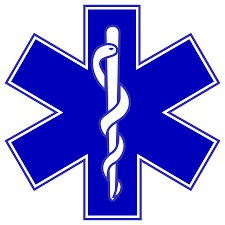
Asclepius was a mythological Greek god, the son of Apollo. In the myth, he grew so proficient that he could not only cure any illness but also resurrect the dead. He was struck down by a thunderbolt from Zeus, who feared that bringing back the dead would shatter the natural immortal-mortal boundaries of the universe. Asclepius was eventually placed into the heavens as the constellation Ophiuchus (the Serpent Holder) the 13th constellation.
In one of the ancient stories of how Asclepius acquired his vast medical knowledge…..
It was said that the secrets of his healing arts came from a serpent that whispered them into his ear. For hundreds of years, the cult of Asclepius maintained healing temples called Asclepeions where live non-venomous snakes would roam freely as the healers performed their rituals. This species is known today as the Aesculapian Snake.
Ancient physicians were known as Therapeutae of Asclepius. It is even said the Hippocrates, “father of medicine”, began his career in one of these temples on the island of Kos, and Asclepius was even featured in the original text of the Hippocratic Oath:
The Hippocratic Oath, is traditionally attributed to Hippocrates of Kos, though historians debate whether he wrote it personally or if it was composed by his followers within the Hippocratic Corpus. It represents the earliest expression of medical ethics in the Western world, establishing principles like patient confidentiality and non-maleficence that still guide modern medicine.
The oath fell into obscurity for centuries until church scholars revived it in the Middle Ages. “The Oath was then rediscovered in the Middle Ages by church scholars who began modifying or interpreting it to conform to medieval Christian doctrines.
Apollyon The Destroyer
They had as king over them the angel of the Abyss, whose name in Hebrew is Abaddon and in Greek is Apollyon (that is, Destroyer).
12 The first woe is past; two other woes are yet to come.
13 The sixth angel sounded his trumpet, and I heard a voice coming from the four horns of the golden altar that is before God. 14 It said to the sixth angel who had the trumpet, “Release the four angels who are bound at the great river Euphrates.” 15 And the four angels who had been kept ready for this very hour and day and month and year were released to kill a third of mankind. 16 The number of the mounted troops was twice ten thousand times ten thousand. I heard their number.
A cavalry refers to mobile military forces traditionally mounted on horses that have evolved into modern armored and mechanized units.
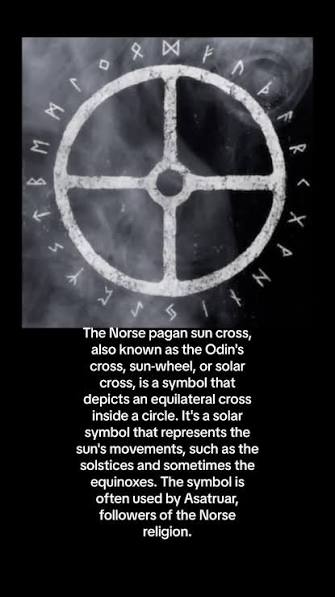
Asatru was the ancient worship of Odin, Thor, and Freyja.
Solar Wheels are simple equal-armed crosses inside a circle. They represented the four seasons, the sun’s movement, and the four cardinal directions.
20 The rest of mankind who were not killed by these plagues still did not repent of the work of their hands; they did not stop worshiping demons, and idols of gold, silver, bronze, stone and wood—idols that cannot see or hear or walk. 21 Nor did they repent of their murders, their magic arts, their sexual immorality or their thefts.