
This information was taken from historical books, documents, newspaper articles, Wikipedia and of course the most notable of all sources, the Bible. The blog you are about to read has been researched, organized, and laid out using information that may be offensive to some readers. These analysis were not put together in judgment, malice or grievance toward any group or individual. This information is esoteric and intended to assist the followers of “the way,” in discovering new information.
Who Were The Jews?
When the Roman Empire took control of Jewish territories, they re-named them the province of Iudaea in Latin. The Romans called the people living there iūdaeus (referring to people of the Yehudim tribe). Over the centuries following the fall of the Roman Empire, the Latin iūdaeus was gradually shortened in medieval European languages. Through Old French variants used after the Norman Conquest, the word was eventually trimmed further into the modern English word “Jew.”
Although mainstream Western history focused completely on the Jews who migrated from North Africa into Europe (becoming the Sephardic and Ashkenazi lineages); African oral histories and other ancient hidden texts tracks a migration southward into the interior of the continent.
When Roman, Greek, and early Christian writers documented these locations, they described the Yehudim populations, their devout practices, legal status, and their conflicts with the state.
Beginning In Egypt (Alexandria and the Nile)
Where writers have documented how Egypt once had the largest population of Yehudim in the ancient world.
- The Greek geographer Strabo (wrote in the early 1st century) that Jews (the Yehudim) occupied a massive portion of the city of Alexandria. He wrote that “a large part of the city is allocated to this nation” and noted they had their own autonomous governor (ethnarch) who regulated their laws.
- The Greek-Egyptian philosopher and writer Philo (though Jewish himself, noted that over one million Jews lived throughout Egypt, stretching from the Mediterranean coast down into Upper Egypt along the Nile.
- The Byzantine church historian Socrates Scholasticus documented in the year 415 CE, writing explicitly about the Christian governor expelling the entire Jewish population from Alexandria following very intense urban rioting.
In 415 CE…
The death of Gamliel VI marked the end of the hereditary patriarchal dynasty in the Land of Israel. The Roman Emperor Theodosius II refuse to allow a successor, effectively ending the highest traditional court and central leadership body, the Sanhedrin. The Roman government then took control of special taxes previously used to fund central Jewish community activities.
Did you know: The Horn of Africa (Ethiopia) was one of the most prominent migrations in East Africa. The Beta Israel (Ethiopian Jews) have a rich, verified historical and textual heritage tracking their lineage back to ancient Israel. They established an independent kingdom in the Simien Mountains of Ethiopia that lasted for centuries.
In Cyrenaica (Modern Libya)
During Greek, Persian, and Roman rule, Jewish communities expanded across North Africa and the Mediterranean, including Egypt, Cyrenaica, and Punic territories. Opinions are mixed on the exact timeline of early settlement in Carthage, with archaeological records pointing primarily to the Roman period rather than early Punic times.
The region of Cyrenaica (eastern Libya) was heavily recorded by Roman historians due to massive geopolitical revolts.
Historical records show that Sub Saharan Hebraic and Yehudim presence developed throughout the trans-Saharan trade routes. The genetic and cultural ancestry of modern North African Jewish communities stemmed primarily from historical migrations of North African, Egyptian, and Iberian exiles rather than a direct, uninterrupted continuity from ancient Carthaginians.
The Trans-Saharan (Arab Slave Trade) Routes lasted for several centuries. Eventually, Arab-Islamic conquests pushed Jewish (Yehudim) communities from the Mediterranean coast southward across the Sahara Desert along trading corridors.
Hebraic populations in regions like the Congo and southern Africa largely reflected later trade expansions. Colonial-era arrivals, or distinct indigenous group traditions (such as the Lemba in southern Africa) rather than ancient Punic-Carthaginians begin to scatter.
The Lemba people are a Bantu-speaking community in southern Africa with oral and genetic traditions tracing back to Semitic and Jewish roots. They resided primarily in South Africa, Zimbabwe, Malawi, and Mozambique.
Did you know: DNA studies show that a notable portion of Lemba male lineages carry Semitic Y-chromosome markers, including the Cohen modal haplotype linked to Jewish priestly (Lewi) families.
Several Hebraic nomadic groups also moved across the Sahara from Nubia and the ancient kingdom of Kush towards West Africa.
Trade and Travel
Hebrew (Yehudim) traders moved south across the Sahara from Morocco, Tunisia (Carthage region), and Egypt alongside Berber and Arab groups.
Historical records also noted Hebraic presence in the ancient kingdoms of Ghana, Mali, and Songhai between the 8th and 16th centuries.
Did you know: The Trans-Saharan slave trade, was established between the 7th and 8th centuries? It continued throughout the Middle Ages. Arabs, Berbers, and other ethnic groups of the Middle East ventured into Sub Saharan Africa starting along the Nile Valley towards Nubia, and across the Sahara towards West Africa Stealing assorted resources along with many Yehudim people.
Many Yehudim Were Forced To Convert To Islam
Historians like Leo Africanus (writing in 1526) documented vibrant, prosperous Jewish trading communities living in the Sahel, particularly around the Oasis of Timbuktu and the Mali/Songhai Empires. Textual accounts note that in 1492, a local ruler named Askia Muhammad forced these Jews to convert to Islam or face exile, leading many to assimilate directly into West African ethnic groups like the Fulani, Wolof, and Soninke
Religious groups, such as the Muslims and later Christians sought to obtain the Yehudim and Africans for their Slave Trade. During this time, there was a constant demand for melanated captives in many eastern Arab nations and Constantinople (previously known as the Byzantine Empire; or Eastern Rome).
Joel 3:2 I will gather together all the (Heathen) nations (that were hostile to My people) and bring them down into the valley of Jehoshaphat (meaning the LORD has judged). And there I will deal with them and enter into judgment with them there for their treatment of My people, My inheritance, Ya’akov whom they have scattered among the nations, and because they have encroached on My land and divided it up.
The Valley of Jehoshaphat is physically located in Yerushalayim, sitting directly between the eastern wall of the Old City (including the Temple Mount) and the Mount of Olives. Today, this geographic depression is universally identified and known as the Kidron Valley.
Kidron (Qidrōn) means “the dark one” in Hebrew.
The Kitos (Quietus) Wars
Did you know: Kitos is short for Lusius Quietus a cruel and brutal general?
- Tacitus and the Greek historian Appian wrote extensively about the “Kitos War” (115–117 CE). They documented that a massive population of Jews (Yehudim) were living in Cyrene (Libya). Appian described how the local Jewish population rose up against the Greco-Roman citizens, destroying pagan temples, and fighting a devastating guerilla war across the Libyan countryside before Roman legions crushed them.
The Kitos War: Was sparked by a combination of religious taxation, underlying ethnic tensions with Hellenistic Greeks, and the depletion of Roman troops in the eastern Mediterranean while Emperor Trajan was away fighting the Parthian War. With Roman garrisons thinly stretched, Jewish communities in North Africa, Cyprus, and Egypt revolted.
Emperor Trajan sent two generals, Marcius Turbo and Lusius Quietus, to crush the revolts. The Roman suppression was incredibly brutal, resulting in massive casualties and the near-total devastation of Jewish communities in those regions.
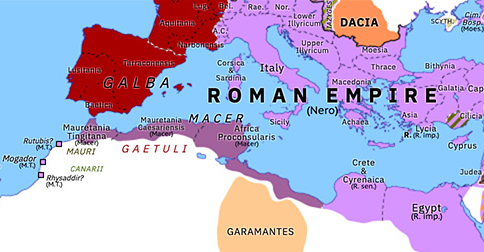
In Numidia and Carthage (Modern Algeria and Tunisia)
As Christianity grew in the 4th and 5th centuries, non-Jewish and early Latin Church writers frequently wrote about Jews living directly in their neighborhoods.
- Augustine of Hippo, a famous theologian and bishop living in Hippo Regius (modern Annaba, Algeria), wrote extensively about Jews living in his region. In his letters and books like The City of God, Augustine described the physical presence of Jews practicing their Sabbath and customs right alongside Christians in North African cities.
- He noted their dispersion to “nearly all lands” and famously argued that Roman authorities should allow them to survive in their locations as physical witnesses to ancient biblical history.
- In regard to the first Roman/Yehudim war, fought between 66-73 CE, Flavius Josephus stated, “General Vespasian and his son Caesar Titus fought against the Jews (Yehudah). Millions of Jews fled into Africa, among other places, fleeing from Roman persecution and starvation during the siege.”

The Kingdom Of Juda
What Went Wrong?
Isaiah 58:13-14 “If you keep your feet from breaking the Sabbath and from doing as you please on my holy day, if you call the Sabbath a delight and the Lord’s holy day honorable,
and if you honor it by not going your own way and not doing as you please or speaking idle words,14 then you will find your joy in the Lord, and I will cause you to ride in triumph on the heights of the land and to feast on the inheritance of your father Jacob.” For the mouth of the Lord has spoken.
This leads us to a very important question?
If following the Shabbat is the sign that seals our connection to GOD, then What do you think it means to practice Sunday keeping? Wouldn’t that be the very opposite of GOD’s command? Could this be Satan’s mark of disgrace?
Who Is Responsible For This Great Diversion?
The Catholic Record of London, London Ontario, on Sept 1st 1923 explains it perfectly….
“Sunday is our mark of authority, the church is above the Bible, and this transference of Sabbath observance is proof of that fact.”
History agrees that it was Constantine the Great and the Catholic Church, who replaced the Shabbat, the seventh day with the first day, Sunday. This is what they have repeatedly described as their “mark!” A pagan day that boldly goes where no one should ever follow. This statement acknowledges how the office of pope, is clearly the office of the “Little Horn;” converting righteous worship into paganism and idoltry.
Yehudim In Mauretania
Even at the furthest western edge of the Roman Empire, non-Jewish records places Yehudim on the very visible map.
- Roman municipal and tax records tracked the city of Volubilis (in modern Morocco). While classical texts are brief, Roman archaeological data from the 3rd century CE provides the absolute proof.
- Archaeologists found Roman-era gravestones in Volubilis written in Greek and Latin tracking Jewish citizens. One specific inscription names a man, Kaikilianos, explicitly calling him the “head of the Jewish synagogue” in that Moroccan city. They also dug up clay and bronze oil lamps decorated with Jewish Menorahs in the ruins.
Black Israelites
Did you know: The Hebrew word (Ashur) “Ashchuwr” meant Black Israelite in Strong’s Lexicon #806! (Ash-khoor) is defined as a, “black” Israelite.
806a (Ashcur) “black,” an Israelite (Ashcur) an Israelite probably from Shachar; black; an Israelite,
Jeremiah 17:3; MY mountain in the land and your wealth and all your treasures I will give away as plunder, together with your high places, because of sin throughout your country. 4) Through your own fault you will lose the inheritance I gave you.
Carthage and North Africa:
Many local traditionalists and historians suggest early contact, and clear evidence of an established Hebraic presence in Carthage emerging by the second and third centuries CE under Roman rule.
So, What Happened To Them?

I mean, What Really Happened To Them?
When ancient writers mentioned the Jews and their location in North Africa, they described them as:
- Distinct and Unassimilated: Living in specific quarters of cities (like Alexandria) with their own courts.
- Highly Mobile: Moving along established Mediterranean maritime trade routes.
- A Significant Tax Base: Tracked by Roman tax collectors via the Fiscus Judaicus across Egypt, Libya, and Tunisia.
Exact Texts From Ancient Writers
- Texts were obtained from Strabo describing how widespread Jews were in the Mediterranean.
- Writings of Augustine detailed his daily interactions with the Jewish community of Algeria.

Why Do They Silence The Voices And Hide The Books?
Augustine of Hippo, a North African of Berber descent and supporter of slavery, served as bishop of Hippo Regius (modern-day Annaba, Algeria) from 395 to 430 CE. He left a large record of letters, sermons, and theological treatises that documented a vibrant, integrated Jewish population living right alongside his North African Christian flock. But, most don’t know about them.
Augustine’s letters to his contemporary, Jerome, revealed that he regularly interacted with local Jewish linguists in North Africa to help clarify the Bible.
Augustine even notes that the bishop, Jerome, formally brought in local Jewish scholars to examine the Hebrew texts. The Jewish experts sided with the old translation, which Augustine used to validate his congregation’s stance. Augustine openly admitted that he regularly sought the linguistic and traditional expertise of African Jews to decipher obscure Old Testament passages.
The Trans Atlantic Slave Trade
Around 1444, Spain and Portugal, began to kidnap and illegally transport hundreds of thousands of Yehudim and West African residents, taking them to Europe, the Americas and multiple islands scattered around the Atlantic. Around 1482 the Portuguese established the Elmina Castle trading post on what they labeled, “the Slave Coast,” which is present-day Ghana. This event marked the beginning of a long period of European colonization and trade in West Africa, which greatly effected the Jews (Yehudim). Later around 1526, these captives were shipped as far south as Brazil, and Cuba.
Biblically This was the penalty, placed upon the descendants of the 12 tribes, particularly the Yehuda, Lewi and what was left of the Benyamin tribe!
Isaiah 28:16 “Therefore this says the LORD GOD: ‘Behold, I lay in Zion a stone for a foundation, a tried stone, a precious cornerstone, a sure foundation. (Yehoshua)
Zion (Hebrew) a mountain in Yerushalayim, representing what will become the Mountain of GOD.
Jeremiah 30:17 For I will restore health to you, and your wounds I will heal, declares the LORD, because they have called you an outcast: ‘It is Zion, for whom no one cares!’
The origin word, for Zion, is tsiyyah, it means dryness and drought, a dry place, or parched land, barren, wilderness. This tells us, that neither the people of Zion, nor the land are who, or what, the world perceives them to be, for out of this dry and barren space GOD’s foundation was firmly set.
